

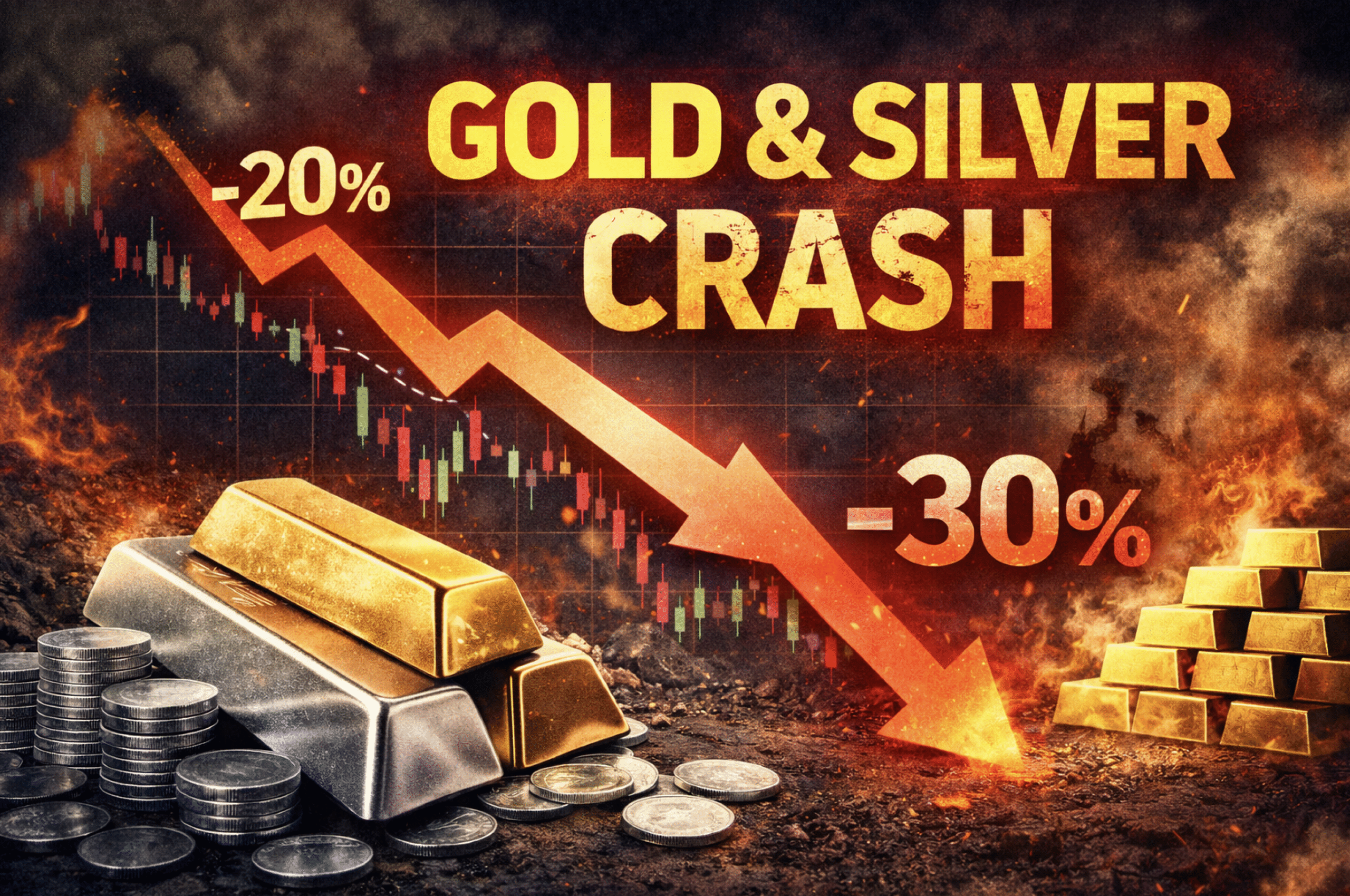
Last Friday felt violent if you were watching the screens.
Gold fell roughly 20%. Silver dropped more than 30%.
It was the biggest single-day drop either market had ever seen.
Cue the panic headlines. Cue the victory laps from people who have been calling the top for months. Cue the breathless declarations that the precious-metals rally is “over.”
But here’s the thing most investors miss in moments like this…
Nothing about this move was surprising, unhealthy, or bearish in the bigger picture.
In fact, it was necessary…
The Shakeout We Had to Have
Gold and silver had gone very far, very fast.
Prices had detached from trendlines.
Momentum traders were piling in.
Retail FOMO was everywhere…
Short-term positioning had become lopsided.
And markets were aggressively pricing in rate cuts from an increasingly dovish Fed narrative that simply wasn’t going to hold.
When trades get that crowded, they break.
And what we witnessed wasn’t the end of the rally. It was a classic shakeout — the kind that clears the runway for the next leg higher.
Why the Drop Looked So Ugly
Let’s be clear about what actually happened…
This wasn’t a sudden collapse in long-term fundamentals. It was a positioning event.
Momentum traders chase price, not value.
When gold and silver were screaming higher, they chased.
When prices finally stalled, they ran for the exits at the same time.
Add in leveraged players, algorithmic trading, and thin liquidity, and you get waterfall price action.
Retail investors piled in late, exactly as retail always does.
That created weak hands — investors with no conviction, no time horizon, and no tolerance for volatility.
Weak hands never survive corrections.
On top of that, markets had become almost religiously convinced the Federal Reserve would pivot aggressively toward rate cuts.
A softer Fed narrative helped fuel the last vertical move.
But when it became clear the future leaders of the Fed are far more concerned about defending the dollar than juicing growth at all costs, that assumption cracked.
When assumptions crack, trades unwind.
The Fed Isn’t Your Friend — And That’s Fine
One of the biggest misunderstandings right now is the belief that gold and silver only go up when the Fed is dovish.
That’s not how real bull markets work.
Yes, ultra-easy money can light the match. But sustained precious-metals bull markets are driven by loss of confidence, not stimulus.
The Fed’s renewed focus on a strong dollar doesn’t invalidate the metals thesis. If anything, it reinforces it…
Why?
Because a central bank fighting inflation, currency instability, and geopolitical fragmentation is admitting the system is under strain.
Strong-dollar policy doesn’t magically fix debt levels, deficits, or trust in fiat systems. It just slows the bleeding.
And gold doesn’t need the Fed to cut tomorrow. It needs the world to remain structurally unstable.
Fortunately for precious metals investors, that condition is very much intact…
The Trend Never Broke
Here’s the part that should matter most to investors who think in months and years, not hours.
After the selloff, both gold and silver snapped right back into their prior uptrends – the ones they were in before prices started to go parabolic.
That’s textbook bull-market behavior.
Big corrections don’t end bull markets — they define them. They reset sentiment, cleanse leverage, and deliver control back to strong hands.
If gold and silver were truly broken, they wouldn’t have stabilized where they did.
They wouldn’t have attracted buyers immediately. And they certainly wouldn’t have reclaimed trend support as quickly as they did.
This wasn’t distribution. It was rotation.
What Changed — And What Didn’t
Short-term catalysts shifted.
Rate-cut timing moved. Momentum cooled. Speculative excess got wrung out.
But the macro drivers that launched this rally in the first place haven’t moved an inch.
Let’s run through them…
- The Global Debt Problem Isn’t Solved
Global debt levels are still staggering. Sovereign debt continues to climb. Deficits remain structural, not cyclical. Governments are rolling obligations forward, not paying them down.
Gold thrives when debt becomes unmanageable — and we crossed that line years ago.
Nothing about a one-day price collapse fixes a debt supercycle.
- Currency Confidence Is Still Eroding
Central banks can talk about strong dollars all they want. But currency trust is about confidence, not rhetoric.
We’re watching de-dollarization accelerate, regional currency blocs form, and central banks diversify reserves away from fiat exposure.
Gold is the neutral asset in a fragmented monetary world. That hasn’t changed — it’s accelerating.
- Central Banks Are Still Buying Gold
This is one of the most underappreciated forces in the market.
Central banks aren’t momentum traders. They don’t chase spikes. They buy strategically, quietly, and persistently.
Their buying didn’t stop because gold corrected. If anything, it likely increased.
When official institutions accumulate gold during volatility, it tells you everything you need to know about long-term confidence in fiat systems.
- Inflation Is Sticky — Not Dead
Inflation may not be screaming higher every month, but it’s embedded.
Services inflation remains elevated. Energy prices are volatile. Supply chains are fragile. Labor markets remain tight. Fiscal spending isn’t slowing.
Gold doesn’t require runaway inflation. It requires persistent erosion of purchasing power.
That erosion continues.
- Geopolitical Risk Is Structural Now
This isn’t a single conflict or flashpoint. It’s a global realignment.
Trade routes are being rerouted. Supply chains are being reshored. Defense spending is surging. Resource nationalism is rising.
These forces increase costs, reduce efficiency, and amplify uncertainty — all bullish for hard assets.
Gold and silver don’t price peace. They price risk.
- Silver’s Structural Deficit Is Still Growing
Silver’s selloff looked especially brutal, but its fundamentals remain explosive.
Industrial demand continues to surge — driven by electrification, AI infrastructure, solar, and advanced manufacturing. Mine supply isn’t keeping pace. Above-ground inventories are thin.
Silver didn’t suddenly become less necessary to the global economy because of a one-day liquidation event.
If anything, this correction reset one of the most asymmetric opportunities in commodities.
Why Corrections Create Fortunes
This is the part that separates investors from spectators.
Most people buy strength and sell fear. That’s why most people underperform.
But the best opportunities in bull markets don’t come when prices are screaming higher and everyone agrees.
They come right after brutal shakeouts, when confidence is low but fundamentals are intact.
That’s where we are now.
Gold and silver flushed out leverage.
Weak hands are gone. Momentum traders have moved on to the next shiny object.
What remains is value — and a powerful long-term trend.
The Real Opportunity: The Miners
If you want torque, this is where it gets interesting.
Historically, miners lag metals early in bull markets. Then, once margins expand and earnings explode, they play catch-up — violently.
A pullback in metals resets entry points in high-quality producers and developers.
Costs don’t rise as fast as prices recover. Cash flow snaps back. Balance sheets strengthen.
This is where outsized gains are made.
Not by chasing parabolic charts — but by buying quality miners when fear briefly returns.
The Bottom Line
Last Friday’s selloff wasn’t a failure of the precious-metals thesis.
It was a stress test — and gold and silver passed.
The macro drivers are intact. The trends are intact. The long-term opportunity is intact.
Corrections like this don’t end bull markets. They reward prepared investors.
This is a buy-the-dip moment.
Accumulate gold. Accumulate silver.
And start hunting for the miners with the strongest leverage to the rebound — because when the next leg higher unfolds, it won’t wait for consensus.