

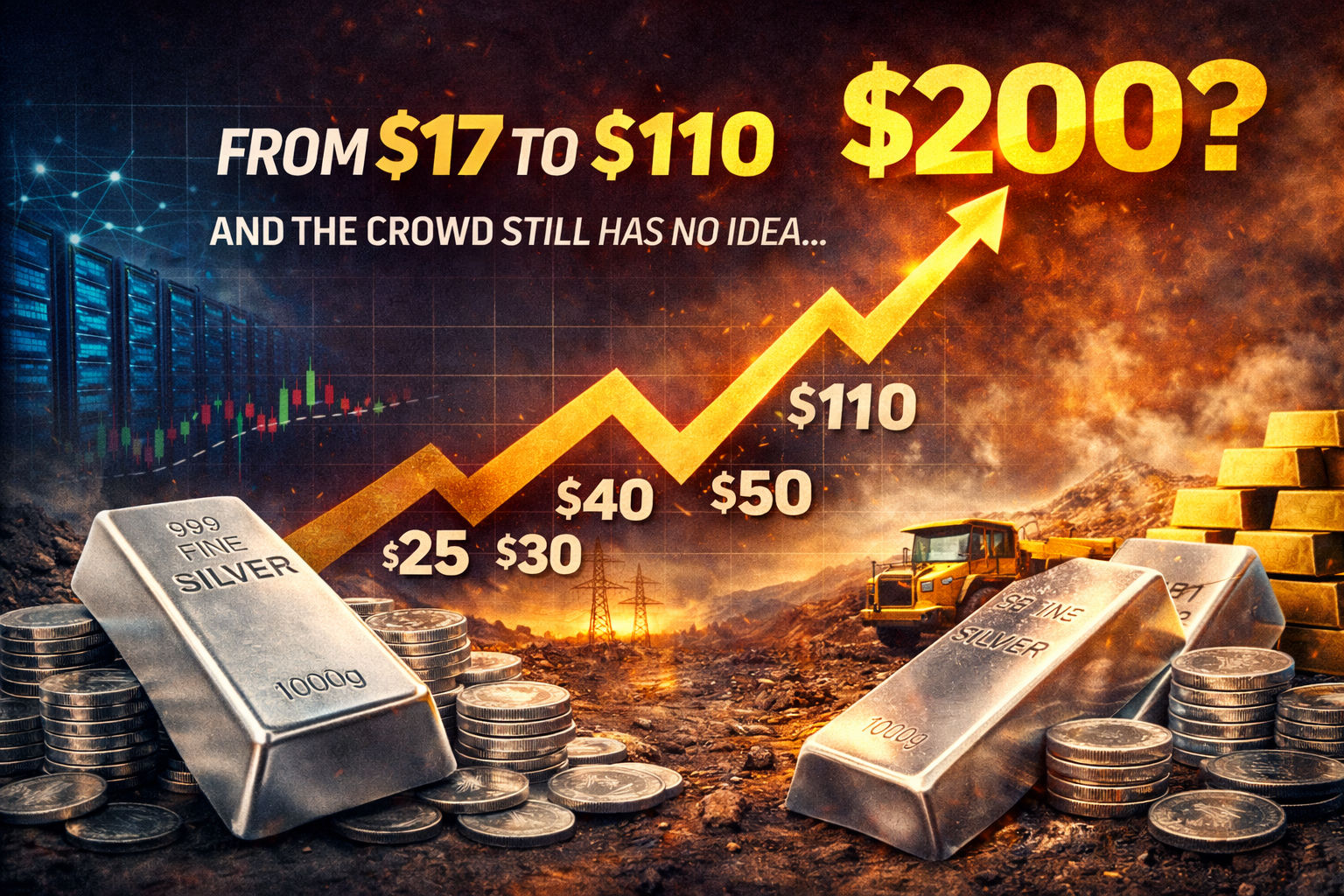
Do you remember? Back when we first started practically begging investors to get into silver?
Because I remember it vividly…
When $17 Silver Made People Uncomfortable
When we first started imploring folks to buy silver—and more importantly, to buy silver miners—silver was trading around $17 an ounce. That wasn’t all that long ago.
Back then, the idea that silver could triple, quadruple, or do something truly unthinkable sounded… irresponsible.
People smiled politely, nodded, and then explained why it couldn’t happen.
Then silver ran to $25.
Then $30.
Then $40.
Then $50.
At each stop along the way, a new crowd of analysts showed up to explain why this level was clearly the top.
And now here we are, with silver trading above $110 per ounce, and the same script is being recycled yet again…
“Overdone.”
“Speculative excess.”
“Ripe for a crash.”
It’s almost comforting how predictable it all is.
Because once you zoom out and look at the bigger picture—the historical context, the macro forces, and the earnings power that’s about to hit the silver mining sector—it becomes painfully obvious that this move isn’t over.
It’s only halfway done…
The $200 Reality Wall Nobody Wants to Talk About
Here’s the part that gets conveniently ignored.
Silver’s all-time nominal high was roughly $50 per ounce, reached in 1980.
That number gets thrown around constantly, usually to argue that silver has already “blown past” its historical ceiling.
But nominal prices are meaningless without inflation…
And, adjusted for inflation, that $50 in 1980 equates to roughly $200 per ounce in 2026 dollars.
In other words, silver would need to trade near $200 just to match its prior real peak.
At $110, silver hasn’t doubled its old high…
It hasn’t even reached it.
We’re sitting at roughly half of silver’s real, inflation-adjusted peak, and analysts who missed the entire move from $17 are suddenly very confident that the game is over.
History suggests otherwise…
Why the Macro Forces Pushing Silver Higher Haven’t Changed
One of the easiest ways to tell whether a bull market is finished is to ask a simple question:
Have the forces that created it disappeared?
In silver’s case, they haven’t just remained intact—they’ve intensified…
Inflation hasn’t been “defeated”; it’s been embedded.
Governments are running structurally larger deficits than at any point outside of major wars, and central banks are trapped between protecting currencies and preventing systemic collapse.
Real interest rates remain deeply unattractive, even after aggressive tightening campaigns.
At the same time, global de-dollarization is no longer theoretical.
Central banks are buying gold at record rates, and silver—historically gold’s volatile, torque-heavy cousin—has always followed once monetary fear turns into monetary action.
Then there’s the industrial side, which this cycle has weaponized…
Silver isn’t just money. It’s a critical industrial metal.
Solar panels, electric vehicles, advanced electronics, medical applications, defense technology, AI hardware—these are not “nice to have” demand sources.
They’re structural, policy-driven, and growing faster than new supply can be brought online.
Mining supply, meanwhile, remains constrained by years of underinvestment, declining ore grades, and geopolitical risk.
You don’t fix that with a price spike. You fix it with a decade of capital deployment—and that process hasn’t even started yet.
This is not a momentum trade. It’s a collision between monetary reality and physical scarcity.
The Earnings Shock That Hasn’t Hit the Tape Yet
Here’s where things get especially interesting—and where most people are still asleep…
Silver miners report earnings with a lag.
That means the financial statements investors are just now seeing reflect a very different pricing environment than the one we’re living in today.
In Q4, average silver prices ranged roughly between $50 and $60 per ounce.
And even at those levels, margins expanded dramatically…
Costs didn’t double. Energy didn’t triple. Labor didn’t suddenly spiral out of control. The incremental revenue flowed straight to the bottom line.
Now look ahead to Q1…
Those earnings will reflect sustained silver prices above $100 per ounce.
That’s not a linear change—it’s an earnings earthquake.
Margins don’t just improve at these levels… They explode.
Cash flow surges. Balance sheets strengthen. Exploration budgets expand.
And suddenly, the same institutions that ignored silver miners at $20 are scrambling to rebuild exposure at any price.
This is how re-ratings happen. And silver miners, historically, don’t re-rate politely.
Why Silver Miners Are Financial Leverage Disguised as Stocks
Owning physical silver is smart. It protects purchasing power and anchors a portfolio in reality.
But silver miners are where the torque lives…
A move from $50 to $100 silver doesn’t mean profits double. In many cases, it means profits increase fivefold or tenfold.
Fixed costs stay relatively stable while revenue surges, turning marginal operations into cash machines almost overnight.
Then comes the second wave: capital flows.
As silver prices make headlines, generalist investors pile in…
ETFs rebalance. Momentum funds wake up. Retail chases performance.
And suddenly, relatively small, thinly traded miners are overwhelmed by demand.
That’s when you get the explosive, face-melting moves silver stocks are famous for.
We’ve seen this movie before… And we’re still in the opening act.
Dolly Varden Silver: The Scarcity Premium Story
Dolly Varden Silver stands out because it controls one of the most compelling high-grade silver districts in North America at a time when quality deposits are becoming incredibly scarce.
This isn’t just about ounces in the ground—it’s about jurisdiction, grade, and consolidation potential.
In a bull market, assets like this don’t get valued incrementally. They get repriced wholesale.
As silver prices stay elevated and majors look to replace declining reserves, Dolly Varden becomes exactly the kind of strategic asset that attracts serious attention.
A doubling from here doesn’t require heroics—it requires recognition.
And recognition is coming.
Avino Silver: Cash Flow Meets Upside Torque
Avino brings something many silver juniors lack: operational credibility and cash-flow leverage.
This is a company that can generate real earnings even at last year’s prices while still maintaining enormous upside as silver continues higher.
That combination is powerful, especially as institutions start demanding fundamentals instead of just optionality.
At silver prices north of $100, Avino’s earnings profile changes dramatically, and so does how the market values it.
A 100% move from current levels is a baseline scenario in a sustained silver bull—not an aggressive forecast.
Apollo Silver: Optionality with a Capital “O”
Apollo Silver is pure leverage…
This is the kind of stock that doesn’t just benefit from higher prices—it magnifies them.
As silver climbs, resources that once looked marginal suddenly become economic, and economic projects suddenly become strategic.
Apollo sits at the intersection of rising metal prices, improving project economics, and renewed investor appetite for high-beta exposure.
In past cycles, stocks like this didn’t just double—they shocked people.
And that setup is back.
Why This Isn’t the End — It’s the Beginning of the Crowd Phase
Every major bull market follows the same emotional arc.
First comes disbelief. Then grudging acceptance. Then fear of missing out.
And the headlines calling for a crash tell us that we’re not even in that second stage yet.
Silver at $110 didn’t end the story. But it is forcing people to look up from their models and realize they missed something big.
As prices push higher and earnings catch up, denial will turn into urgency.
And urgency is rocket fuel for a tiny market like this.
Silver doesn’t need hype to get to $200. It just needs time, math, and human behavior to do what they always do.
The bottom line here is that we’re only halfway there… And we’ve still got a lot of massive gains ahead of us.